Brother Broom and His Companions
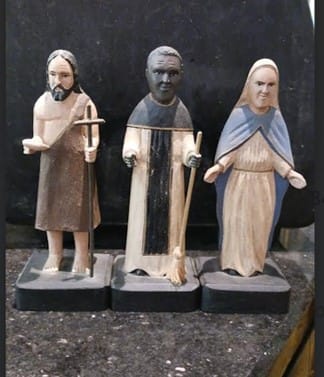
Three wooden figurines. A bearded man with a cross-topped staff in one hand, a seashell in the other. A woman in a blue cloak, with a mannish face, holding nothing at all. And a dark-skinned man in a black-and-white habit, holding a broom.
They began their lives, as figurines, on the island of Puerto Rico in 1991, and ended up in a kitchen display shelf in Mississauga, Ontario.
The Artist
Turn them over and each one introduces itself. On the bare wood of every base, in the same handwriting, are a signature, the words Ponce P.R. 1991, and a name. The bearded man is San Juan Bautista, John the Baptist. The woman is the Virgen Milagrosa, Our Lady of the Miraculous Medal. The man with the broom is San Martín: Martín de Porres of Lima, known as Fray Escoba, Brother Broom.
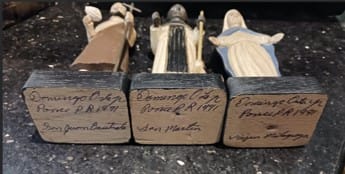
The maker’s name is Domingo Orta. He is dead now. He came before the saints, so we begin with him. Then we shall return to the saints, and to the santos, as Puerto Rico calls carvings like these, and to the odd coincidences between where they began and where they stand today.
There are pictures online of Orta, most taken when he was elderly. In one, he holds up a carving of his own, a Virgin of Montserrat, and looks straight at the camera. He bears an extraordinary resemblance to the father of the man who purchased the figurines: a certain angularity of features, a particular focused stare. This similarity was unknown when the figurines were bought, it is nevertheless striking. But we are getting ahead of the story.
Domingo Orta Pérez was born in 1929 (one source says 1928) in Adjuntas, a coffee town in the mountains of Puerto Rico. His parents farmed. As a boy he made cuatros, the small ten-stringed guitar that is the island’s national instrument, so he knew wood before he knew saints.
The saints came in 1942. He was thirteen, and a travelling carver from the nearby town of Yauco came to the house to repair his mother’s figure of Our Lady of Montserrat. The boy watched. Such a carver is called a santero, and mending and repainting a family’s saints was as much his trade as making new ones.
Orta did not take it up at once. He settled in Barrio El Tuque, in Ponce, on the south coast, and worked as a factory labourer until an illness put an end to that. Then he turned to carving, and found that he could live by it.
He did not carve alone for long. His wife, Santia Rivera, learned the craft, and so did their six children, and in time the children’s husbands and wives. The Museo de Arte de Ponce holds a set of Three Kings by Santia dated 1991, the same year as our three. So “Domingo Orta” on the underside of a saint may be the name of a workshop as much as of a man.
Recognition followed. He was named Artisan of the Year in 1982. The church of Santa María Reina in Ponce commissioned a Christ of Miracles from him. The Ponce museum has two of his pieces, and one biography places others in the Vatican and the Smithsonian.
In 1991, he was sixty-two. That year he, or his family under his eye, carved a John the Baptist, a Virgin, and a Martín de Porres, each about eighteen centimetres tall, and wrote his name beneath them.
He died on June 13, 2007. The Institute of Puerto Rican Culture said that the island’s artisans had lost one of their pillars, and that his legacy would live on in the workshop he had made with his family. It has. The Ortas are still carving in Ponce.
A History of Carvers: The Santeros
What they carve has a long history, and for most of it a santo was not something one bought on holiday.
For centuries most Puerto Ricans lived scattered through the mountains, a long walk from any church and seldom visited by a priest. Religion was kept at home. A household had a small altar, and on it stood its saints, cut from cedar by a local man with a knife and painted in whatever colours he had.
These were working objects. A family asked its saint for things: rain, a safe birth, the recovery of a child. The asking was a bargain, a promesa, with something vowed in return, and a favour granted might be marked by hanging a tiny metal charm on the figure. A saint who did not deliver could be punished. Saint Anthony, whose business was finding husbands, was stood on his head until he found one. When the paint wore thin, the santero came back and painted the figure again, so an old santo wears its history in layers.
Nobody signed them. The saint mattered, the carver did not, and most of the old makers are known today only by the habits of their knives.
The trade nearly died. After 1898 Protestant missionaries discouraged images, and cheap plaster statues did the rest. By the middle of the twentieth century few santeros were left. Then, from 1955, the new Institute of Puerto Rican Culture began collecting the old carvings and showing them as national heritage. Collectors followed, and museums, and craft fairs. A new generation took up the knife, and this time they signed their work. A santo could now be owned by someone who never prayed to it.
Orta stood with a foot on each side of that change. The first santo he knew was his mother’s Montserrat, a working saint old and worn enough to need mending. He carved a Christ for a parish church, to be prayed before. But he also signed and dated his figures, and wrote the saint’s name beneath for buyers who might not recognize it. One of his carvings entered a museum by way of a beer company’s collection of folk art.
Staying at the Hilton
And three of the figures he made in 1991 went north to San Juan, to stand on a shelf in a hotel gift shop.
The Hilton in San Juan was itself a piece of salesmanship. It opened in 1949, built by the Puerto Rican government and handed to an American hotel company to run, with the purpose of bringing visitors and their dollars to the island. Its gift shop offered them the island in portable form.
Orta’s three saints seem to have waited there about two years.
Three Santos for a Santos
The surname of the man who bought them was, of all things, Santos. His first name was Juan, as his father’s was before him, and he was born in San Juan. He had left the island as a very young boy and had been back many times since, but this visit, about 1993, was the first with his wife and their two small children. They stayed a few days at the Hilton. They could not stay long, as their finances would not cover it, and they would shortly continue on to other parts of the island.
The purchase was therefore something of an extravagance. The figurines may have cost ninety American dollars each, or ninety for all three; no one remembers now. But that wasn’t the point. They stood on a shelf, attractively arranged to catch a tourist’s eye, fewer than ten pieces in all, with nothing displayed to say what they were or who had made them.
Juan knew what a santo was, and was not particularly drawn to them. It was his wife who kept the family’s memorabilia, and it was she who stopped at the shelf. She chose three. Only one of her reasons has survived: she liked the broom.
So the one person in the shop who could have said what the figures were had no great interest in them, and the one who wanted them was judging by eye. Juan Santos, son of Juan Santos, born in San Juan, left the hotel built for visitors with three santos, and one of them was San Juan.
The Story of the Saints
Now to the saints themselves, and to what the shelf did not say.
The bearded man is John the Baptist, the desert preacher who baptized Christ in the Jordan. The shell in his hand is for pouring the water, and the rough brown tunic stands for the camel hair he is said to have worn.
He has a particular claim on Puerto Rico. When Columbus reached the island in 1493, he named it San Juan Bautista, and its harbour town Puerto Rico, the rich port. In time the two names changed places. The lamb on the island’s coat of arms is his emblem, and on the eve of his feast on June 23 it is said that people still walk backwards into the sea at midnight for luck. He is also the patron saint of French Canadians, and June 24 is Quebec’s national holiday. Quebec comes into this story too.
The woman is the Virgin of the Miraculous Medal; she is the youngest image of the three. In 1830, a novice in Paris, Catherine Labouré, reported visions of the Virgin standing on a globe with rays of light streaming from her open hands. A medal was struck to the design, and when cures were credited to it during the cholera of 1832 it became the Miraculous Medal. Orta left out the globe and the rays and kept only the gesture. That is why she appears to be holding nothing at all. Her hands are empty because she is giving something away.
The man with the broom is Martín de Porres. He was born in Lima in 1579, the son of a Spanish gentleman and Ana Velázquez, a freed woman of African descent. His father was slow to own him. At about fifteen he entered a Dominican priory as an unpaid servant, because the rules barred a man of his birth from taking vows. Years later the bar was lifted and he became a lay brother. He nursed the sick of every colour and station, begged for the poor, and swept the floors, and Lima called him Fray Escoba, Brother Broom. He died in 1639. Rome did not make him a saint until 1962.
That date matters. The old santeros never carved Martín because, for them, he was not yet a saint. He belongs to Orta’s generation and none earlier, and Orta gave him what identifies him: the white habit, the black scapular, the broom, a dark face and kinky hair.
Martín de Porres, the son of a Spanish father and a mother of African descent, is the patron saint of people of mixed race. Juan Santos is of African, Spanish, Portuguese and Taíno descent, as his father was. His wife is a whiter-than-white Northern European by way of Quebec. It was she who picked the saint out of fewer than ten on a shelf, with no label to tell her who he was, because she liked the broom.
The Deep History of the Objects and Their Real Age
Before we come to the end of the trio’s journey, we should step back a little further in time, to the “DNA” of the objects themselves.
It is almost impossible to say, by looking, which paints were used to finish these humble pieces. By 1991 a workshop like Orta’s would most likely have used artists’ acrylics or ordinary household paint, and the surfaces would fit either: flat black on the plinths, a faint sheen on the figures, as if the colours had been sealed or were of a different kind.
The wood, however, is almost certainly Spanish cedar, cedro, which is not a true cedar at all but a tropical cousin of mahogany. It is soft, straight-grained, faintly spicy to the nose, and disliked by insects, which is why it is used for cigar boxes and why santeros have always preferred it. The figurines are surprisingly lightweight; there is nothing heavy about them.
Where Orta’s cedar came from cannot now be known. The tree is native to Puerto Rico and once grew among the coffee farms of the mountains where he was born. By 1991 the island’s own stands were much reduced, and a busy workshop may simply have bought boards from a lumberyard, cut somewhere in Central or South America. But santeros had long reused old wood, or as we say today “repurposed” it: the leg of a table, the frame of a cabinet, a beam from a house, something still older.
A forest-grown cedar can need eighty years or more to reach cutting size, though plantation trees are quicker, which could push the origins of the figurines back to the early years of the twentieth century. But it is quite possible that the wood was far older, and had its own, now lost and unknowable, history.
Some objects do not give up their secrets, and these figurines, although saying much, still keep much to themselves.
The Journey to a New Home
At last, we are coming to the kitchen in Mississauga, Ontario.
The santos were wrapped in a beach towel and carried around the island while the family visited Rincón and Arecibo. If their wooden ears could hear, they would have heard the coquís chirping all night long. They would have heard the surf at Rincón, and maybe sensed the faint radio signals from space that the great dish at Arecibo was built to catch. (Even the magnificent Arecibo telescope went to ruin in 2020, yet the little santos are still with us.) But mostly they stayed in the towel. The towel was, apparently, blue, just like the Virgin’s cloak.
Then they were packed in the carry-on bags, still in the blue towel, boarded the airplane for Toronto, and were finally driven to Mississauga.
Sharing the Kitchen Shelf
Here they were placed in a kitchen display shelf.
The saint of the broom has spent some thirty years in a kitchen, and has never once been asked to sweep it.
He and his companions share the shelves with a few vintage Japanese Hummel-like figurines, a pair of tarnished silver salt and pepper shakers, binoculars, and a set of 1950s cookbooks. A small United Nations: Japan, England, the United States, Puerto Rico, and, oddly, nothing Canadian other than the shelves holding them all.
A cluster of unrelated objects, united only in that they travelled to Mississauga, near the shore of Lake Ontario, and are living there for now.
The Convergences
Earlier in this essay the odd coincidences were touched upon; where these figures began and where they stand today. Perhaps they are better called convergences.
A family named Santos bought three santos. A Juan, born in San Juan and the son of a Juan, carried home a San Juan, with a wife who came by way of Quebec, where the same saint, as Saint-Jean-Baptiste, is patron. The elder Juan, it turned out, looked remarkably like the man who carved them. And the patron saint of people of mixed race, picked off a shelf for his broom, went home with a man of African, Spanish, Portuguese and Taíno descent, as his father was before him.
So many things in life are connected and converge, including those things we call keepsakes. We need only look closely and quietly.
Sources
All web sources were consulted on or before October 2026.
On Domingo Orta and his family
- "Muere el artesano Domingo Orta." Primera Hora, 13 June 2007. primerahora.com. Death, Adjuntas origin, cuatros, the Instituto de Cultura Puertorriqueña statement, the Cristo de los Milagros.
- "Domingo Orta." MUSAN, Museo de los Santos y Arte Nacional, San Juan. musan.org. Birth (given as 1928), farming parents, Barrio El Tuque, family workshop, date of death.
- "Domingo Orta Pérez (1929–2007)." Find a Grave memorial 19869633. findagrave.com. Unattributed English biography: the 1942 repair of his mother's Montserrat, factory work and illness, Artisan of the Year 1982, collections claimed; photograph captions.
- "Domingo Orta Pérez." Museo de Arte de Ponce, online collection. emuseum.museoarteponce.org. Dates 1929–2007; two works held.
- "Miracle of Hormigueros," 1991, object 2009.2475.48. Museo de Arte de Ponce. emuseum.museoarteponce.org. Gift of Colección Budweiser de Arte Popular de Puerto Rico; also lists Santia Rivera Martínez (de Orta), The Three Wise Men, 1991.
- "Santos & Reyes." Puerto Rican Art & Crafts, Old San Juan. puertoricanart-crafts.com. The six children, cedar as the family's wood, current sizes and prices.
- "Santos de Palo." Casa Paoli, Ponce. casapaolipr.com. Dates 1929–2007; captions the Hormigueros piece as 1998.
- Nusz, Nancy, collector. "Santo carved by Jose Orta, Miami, Florida," 1985. State Archives of Florida, Florida Memory. floridamemory.com. Background on a José Orta of a Ponce santero family; not used in the essay.
- Fritz, Sonia, director. Los Santos Reyes Magos (1997). Known here only from a film database listing; the film itself was not viewed.
The objects and the family account
- The three figures themselves: inscriptions on the bases, height, weight, surface.
- The recollections of the Santos family: the trip, the hotel shop, the price, the choice of figures, the journey home.
On the Caribe Hilton
- "The Caribe Hilton Hotel: More than 7 decades of hospitality growth and cultural celebrations." Puerto Rico Industrial Development Company. pridco.pr.gov. Built by PRIDCO under Operation Bootstrap, leased to Hilton, opened 9 December 1949.
- "Expanding Beyond the Continental United States." Hilton, Stories from Hilton. stories.hilton.com. Hilton's first hotel outside the continental United States; its effect on tourism.
On the santos tradition
- "Talla de santos" (wood carvings of saints). Enciclopedia de Puerto Rico, Fundación Puertorriqueña de las Humanidades. enciclopediapr.org. Origins in the 17th century, distance from churches, home altars, the word santero.
- "Santa Barbara," 18th century, object 1996.91.57. Smithsonian American Art Museum, Teodoro Vidal Collection. americanart.si.edu. Small santos for private prayer; in most Catholic households by the end of the 19th century.
- "Conservation of Wooden Figures from the Vidal Collection." Smithsonian American Art Museum, 16 February 2024. smithsonianmag.com. Devotional use in churches and homes; layers of repainting.
- "We Remember Collector Teodoro Vidal." Smithsonian American Art Museum, 2016. americanart.si.edu. The Vidal gift to the Smithsonian.
On the three saints
- "St. Martín de Porres." Encyclopaedia Britannica. britannica.com. Born Lima 1579, died 3 November 1639, canonized 1962; parentage; barber-surgeon training; with the Dominicans from fifteen; patron of mixed-race people.
- "Porres, Martin de, St." Encyclopedia.com. encyclopedia.com. His mother Ana Velázquez; the rule against admitting him waived.
- "Puerto Rico's Seal." Welcome to Puerto Rico. topuertorico.org. Columbus's naming of the island San Juan Bautista in 1493; the lamb and the motto on the arms.
- "Saint-Jean-Baptiste Day." Government of Canada, Language Portal. canada.ca. Patron of French-speaking Canadians from 1908; Quebec's national holiday since 1977.
- "Mass in honour of the Patron Saint of the French Canadian People." Archdiocese of Montreal. diocesemontreal.org. Pius X's 1908 proclamation.
- "Chapel of Our Lady of the Miraculous Medal." Wikipedia. wikipedia.org. Catherine Labouré, novice, 1830; the medal of 1832 and the cholera epidemic. A tertiary source.
On the wood and on Arecibo
- Cintrón, Barbara B. "Cedrela odorata L., Cedro Hembra, Spanish-Cedar." In Silvics of North America, USDA Forest Service. PDF. Mahogany family; native range including the West Indies; aromatic, termite- and rot-resistant wood.
- Martínez Prera, Alex, Bryan Finegan, and Laura Snook. "Using Dendroecology to Determine Growth Rates of Mahogany and Cedar in Community Forestry in Guatemala." Tropentag 2016. PDF. Forest-grown cedar reaching cutting size at about 85 years.
- "Iconic radio telescope suffers catastrophic collapse." National Geographic, 1 December 2020. nationalgeographic.com. The collapse of the Arecibo telescope.
Suggested references for further reading
- Cussen, Celia. Black Saint of the Americas: The Life and Afterlife of Martín de Porres. Cambridge University Press, 2014.
- Vidal, Teodoro. Santeros puertorriqueños. San Juan, 1979.
- Lange, Yvonne. "Santos: The Household Wooden Saints of Puerto Rico." PhD dissertation, University of Pennsylvania, 1975.